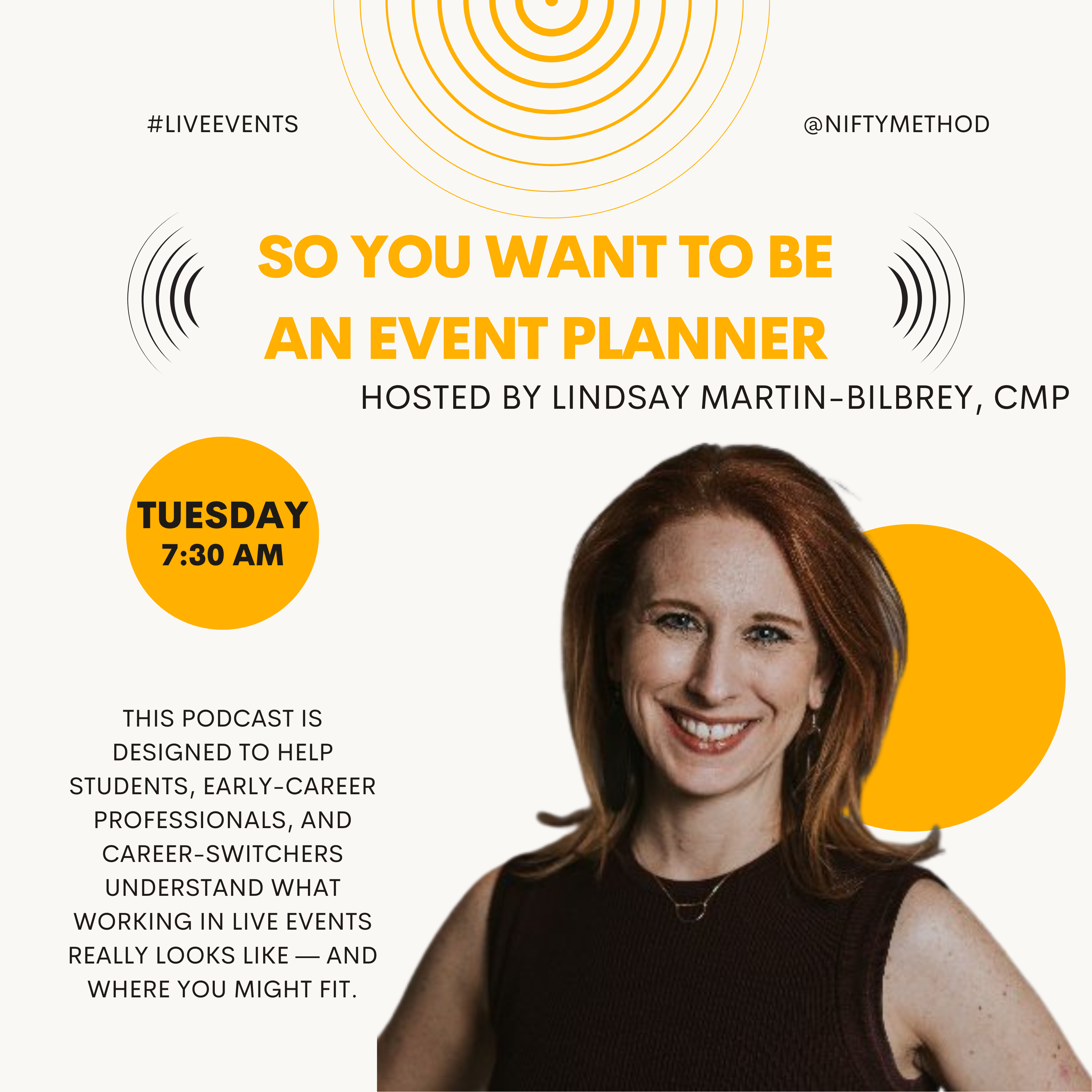
Episode 1
What Even is a Live Event?
When people say they work in live events, it can mean everything, and nothing, at the same time.
So what actually counts as an event, and why does defining it matter?
In this episode of So You Want to Be an Event Planner, we break down what planned live events really are and why they deserve to be understood as a legitimate field of work and study. Using examples from corporate events, festivals, sport, social rituals, and civic life, we introduce a clear definition of events and explain how careers across live events fit within the broader experience industries. We also explore why events are typically taught in hospitality programs in the U.S. and how defining and naming the live event field creates clarity, confidence, and belonging for students, career-switchers, parents, school counselors, and advisors.
If you’re curious about event planning or event management — or wondering whether you belong in this industry — this episode is your starting point.
🔑 Key Ideas
- Events are intentional, temporary, designed, and purpose-driven gatherings
- Events exist across business, culture, sport, civic life, and social spaces
- Event planning is a legitimate interdisciplinary field, not just a job title or side task
- Hospitality became the academic home for events in the U.S. for structural reasons
- Naming the field creates visibility, legitimacy, and belonging
🧠 Language We’re Using
- Planned live events
- Experience industries
- Temporary organizations
- Purpose-driven gatherings
- Event ecosystem
✍️ Try This
Think about the last three events you attended.
What was each event’s purpose, and which sector did it belong to (business, social, cultural, sport, civic)?
Notice how different events serve very different outcomes — even though we often use the same word for all of them.
🎧 Coming Up Next
Episode 2: The Live Events & Experience Industries — A Tour of the Ecosystem
If events are a real field, where do they actually live? We’ll map the industries, sectors, and systems that rely on events — and why event jobs are often harder to see than they should be.
Companies mentioned in this episode:
- Disney
- Walmart
- Coachella
- Olympics
- World Cup
Transcript
Episode 1 what even is an Event? Welcome to so youo Want to Be an Event Planner, a podcast about how people actually find their way into the live events and experience industries.
I created this show because events are everywhere in our lives. Conferences, concerts, weddings, festivals, sports and civics moments. But the field itself is surprisingly invisible.
People work in live events for years without ever being able to explain what the industry really is, how they got into it, or what paths even exist. I'm Lindsay Martin Bilbrey. I've spent over 20 years working across hospitality, live events, strategy, and operations.
I've worked in agencies, venues, brands, associations, and classrooms, and I've seen firsthand how many talented people stumble into this work without a map. This podcast is designed for students who think they might belong in live events, but don't know quite what that means yet.
It's for career switchers who found themselves adjacent to the field and are wondering if there's a place for them here. And it's for parents, advisors, and educators who want better language for explaining what this industry actually is and why it matters.
This isn't a how to show about planning a single event.
It's about understanding the field, the roles, the pathways, the identities and the systems behind live events and experiences so you can decide where you fit inside of it and how to thrive in it. Let's get into it. When people say they work in events, it usually means everything and nothing at the same time.
Are we talking about conferences, weddings, concerts, sports, politics? Today we're doing something surprisingly rare. We're actually defining what an event is and why it's a real field, not just a job title.
Because before you can decide whether or not you belong here, you need language for what here even is. So today's episode is called what even is an event?
And that question might sound basic, but it's actually the root of a lot of confusion in the live events industry because everyone uses the word event, but almost no one defines it.
We talk about event planning, event production, event marketing, event strategy, but we rarely stop to say what an event actually is or why it deserves to be treated as legitimate field of study and work.
And when something isn't clearly defined, it's hard to see how you get into it, where the jobs are, what the job titles might be, whether it's a real career or not, and whether you, with your skills, knowledges and abilities belong here. So that's what we're doing today. We're naming the field a working definition in plain language, with a little bit of research in the background.
In event studies. And yes, that's a real area of research. Scholars actually do define lived events, and they do it very deliberately.
Planned live events are intentional, temporary gatherings that are designed to achieve specific outcomes. Let's break that down. Intentional. Someone decided this live event should happen. They're temporary. The live event has a clear beginning and end.
It is designed. The space, the flow, the content, the timing, all of it is shaped and it is purpose driven.
Something is supposed to happen because this live event exists. Now, that purpose might be economic, it might be cultural, it might be social, political, or personal. But it's never accidental.
And that's important because live events are not defined by how fancy they are, how big they are, or how fun they look on social media. Instead, they're defined by intent, design and purpose.
Examples of planned live events Once you look at events this way, you realize how many forms they take. For example, when I ask students for the first time, what's an event you think about? Most of them will tell me a wedding or a concert.
Here are some other examples. Most commonly, they can be seen as business organizational events.
These are things like conferences, user summits, sales kickoffs, product launches, trade shows, internal leadership meetings.
What that looks like in reality is when Disney goes out to pitch all of their new products and services and films in the spring, or when Walmart goes out and tells you about how they've done in one of their town halls. These business events exist to share knowledge, align their teams, signal value to the marketplace, build relationships and move money.
They're strategic tools, not side projects. Social and life cycle events are just as powerful, but on the other side of the coin.
Weddings, funerals, religious ceremonies, milestones, celebrations such as anniversaries or family reunions. These events typically don't exist to make a profit, but they absolutely create value in identity, continuity, meaning belonging.
They mark transitions in people's lives. Other live events are festivals and cultural events.
Music festivals like Coachella, food and wine festivals, arts and heritage events, seasonal celebrations. These events shape place and identity, drive tourism, support creative economies, and reinforce culture.
Entire cities and countries plan events around them. Another event are sports events, professional and collegiate games, tournaments, marathons, mega sport events like the Olympics or the World Cup.
These are some of the most operationally complex events in the world, blending live audiences, media, logistic safety and emotion at massive scale. Other events are civic, political and public events.
These are your parades, color commemorations, inaugurations, political rallies, public ceremonies. These events organize society. They signal legitimacy, power, memory and collective identity. And finally, mega events. Global summits, world Expos.
And yes, these are also Olympics and World Cups.
You see, they cross over events that reshape cities, justify public investment in tourism and hospitality, and carry symbolic weight far beyond their duration. All of these can look very different. And yet at their core, they are all the same. A planned live event. They share the same DNA.
They are intentional, temporary and designed, purpose driven gatherings. Once you see live events this way, another question usually comes up, especially for students.
Why are events so often taught in hospitality schools in the United States? The short answer is because hospitality was the first academic discipline equipped to teach live service based experiences at scale.
Live events require things hospitality already understood. Things like guest flow, food and beverage service, design, logistics under time pressure, and live environments where failure is very public.
Hospitality schools already had the industry relationships, internship pipelines, applied learning models, and real operational labs. Early event education grew out of hotels, convention services, catering, and destination management.
So events weren't downgraded by being placed in the hospitality schools. Instead, they were incubated here. Hospitality teaches live events how to work.
So if you're studying live events in a hospitality school, that doesn't mean live events are hospitality. It means that hospitality is one of the lenses we use to teach them.
There are four ways to see live events, and one of the reasons live events are hard to define is that they can be understood in multiple ways at once. The formats can be challenging. We have conferences, festivals, ceremonies, competitions, exhibitions.
On their face, they look very different, even though at their core they operate very similarly. From a behavior perspective, it's the same thing we see gathering, celebrating, learning, persuading, mourning, all of those things.
And none of those things may be happening at the live event you've been present at or have planned. But they're a core tenet of what can make a live event.
The industries we live in, hospitality, sport, tourism, entertainment, marketing, the public sector, and then finally the ecosystems. People, labor, venues, vendors, governments, capital, culture. Live events are a field because they operate across all of these layers.
Different formats, behaviors, industries, and ecosystems at the same time. What events are not? One last clarification. Planned live events are not accidental. They're not passive.
Live events are not random, and they're usually not just for fun. Even social events are planned, resourced, designed and meaningful. Intent is what makes something a planned live event.
So why does all of this matter? When we name the field, it becomes visible.
I did a career day once for one of my sons, and when I came in, I told them I worked in hospitality and live events, and they asked me why I planned events for hospitals.
Sometimes the larger frame we use to talk about live events can be confusing to people who don't have as much relevancy because it's so common and they've been to it, but they don't know what it is. They can't really name it. When we name the field, it becomes visible. And then once it's visible, it becomes legitimate.
And when it's legitimate, people or students like yourselves can. Can see themselves inside it, working in it, thriving in it. So before you ask, do I belong here?
In a career for live events, you have to know what here actually is. Now that we've defined what a live event is, the next question is obvious. If this is a real career field, where does it live?
What industry does it belong to? Because events don't belong to one industry, they live across many. And that's what we'll explore next.